
USDT vs USDC: which to use for a crypto swap or transfer
Practical guide to choosing between USDT and USDC using destination support, exact network, current route, and your next transfer.

Choose the token and network that the destination explicitly accepts. If both USDT and USDC are available, check the current route, the expected amount to receive, and what the recipient needs to do next. Neither token is universally better for every swap or transfer.
USDT and USDC are separate dollar-linked tokens, not two names for the same balance. The right choice is usually practical: compatibility first, route details second, issuer preferences after that.
Start with this four-step checklist
- Ask what the destination accepts. Check the exact token, network, receiving address, and any memo, tag, or comment requirement.
- Check what you hold and what must arrive. You may start with USDT while the recipient needs USDC, or hold either token on a network the destination does not support.
- Open the current route. Verify the displayed receiving token, network, expected payout, and all costs shown before you confirm.
- Think one step ahead. If the recipient will send the funds onward, make sure they can use the same token and network at the next destination.
If one of these checks fails, a familiar ticker or an attractive rate does not make the route suitable.
USDT or USDC: choose by situation
| Situation | Practical choice |
|---|---|
| The destination accepts only one token | Use that token on the stated network. |
| Both tokens are accepted on the same network | Check the current route and expected payout, then consider the recipient's next step. |
| Each token is offered on a different network | Choose the exact token-and-network combination the destination supports, not the ticker alone. |
| You already hold one token and the destination accepts it | Keeping that token may avoid an unnecessary conversion, but check the current route first. |
| You are choosing because of issuer documentation | Review both issuers' official pages; documentation preferences do not override destination compatibility. |
A choice that works for one transfer may be wrong for another. There is no need to switch tokens just because a comparison article calls one of them the winner.
USDT and USDC are designed to track the US dollar, but a one-to-one payout is not guaranteed. The expected amount depends on the route's exchange rate and applicable costs.
Why the network matters as much as the ticker
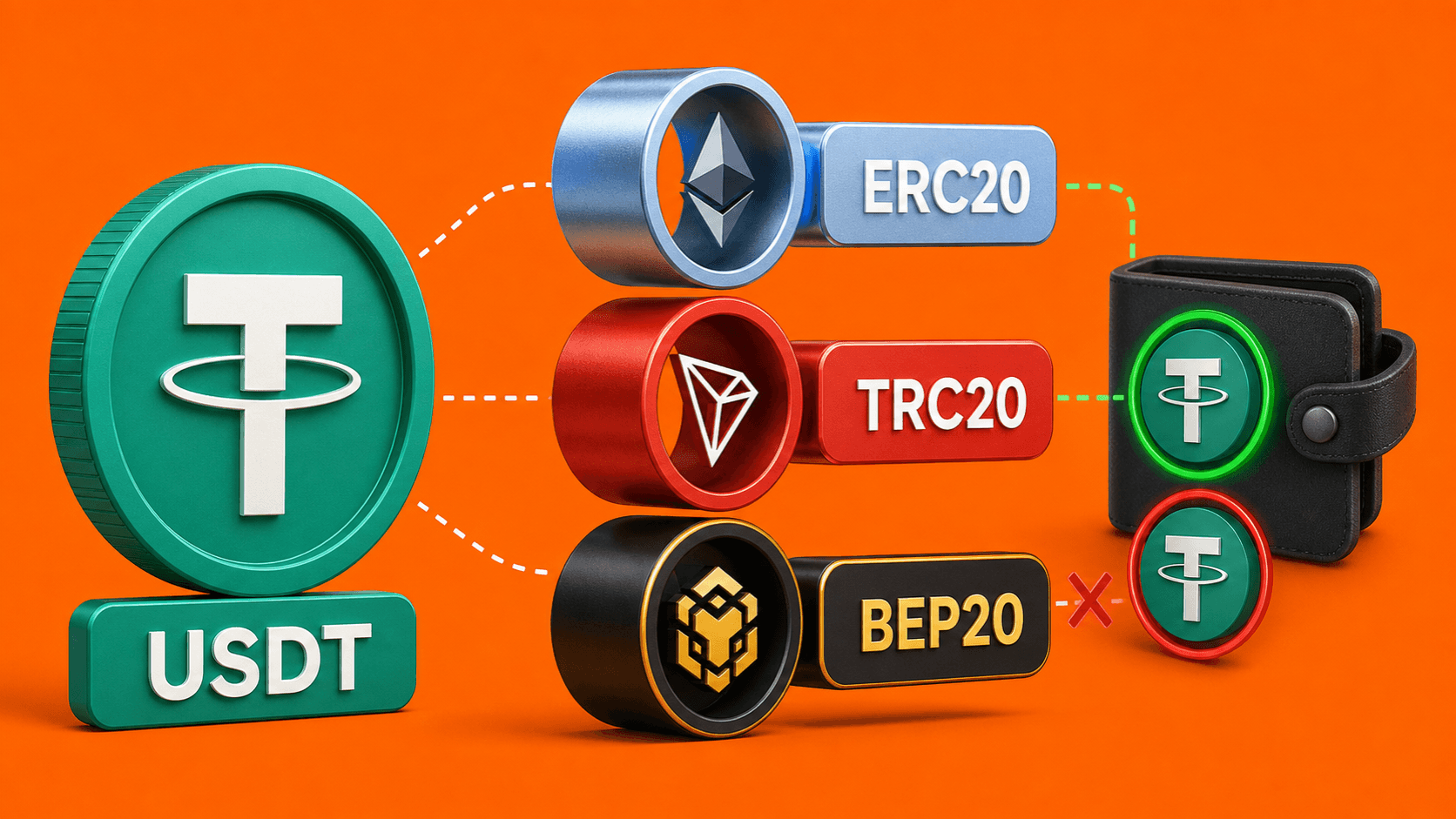
The same token can exist on several networks. A receiving service may support only some of them, and its list can differ from the issuer's full list.
For example, seeing USDT or USDC on a receiving screen is not enough. Look for the complete combination, such as USDT on Tron or USDC on Ethereum, and select that same combination in the sending route. Similar-looking tickers and addresses do not make two networks interchangeable.
This also affects the next step. The recipient may need a particular network to move the funds again, use an application, or withdraw to another service. A route that looks acceptable now can create an extra conversion later.
For a closer look at USDT network selection, read which network to choose for USDT.
What differs besides the route
USDT is issued by Tether, while USDC is issued by Circle. Their documentation, supported protocols, reserve reporting, and redemption arrangements are not identical. Those differences may matter to you, but they do not make either token the automatic answer to every transfer.
Use primary sources instead of repeating a general safety claim:
- Tether publishes its supported protocols and token identifiers. Use this page when you need to verify an official USDT network or identifier.
- Circle publishes current USDC network and reserve information. Use it to review Circle's own documentation and current network list.
The destination still has the final say about what it accepts. An issuer-supported token on a particular network is useful only if the receiving service supports that same version.
An illustrative route check
Imagine that a service gives you these receiving instructions: USDC on Base. You currently hold USDT on Tron.
Do not send USDT on Tron to the displayed address and hope that the service will convert it. Do not choose a route merely because the address looks like an Ethereum address; it must explicitly deliver USDC on Base.
You need a route that explicitly delivers USDC on Base, or you need to ask the service for another supported receiving option. Before confirming, check the expected USDC amount, the receiving network, and any costs involved in getting there.
The same logic applies when you hold ETH and want a dollar-linked asset. LightSwap currently offers ETH to USDT and ETH to USDC routes. Open the relevant route and check the displayed receiving network and expected payout before deciding.
Final checks before you confirm
- The token matches the receiving instructions exactly.
- The route’s displayed receiving network exactly matches the destination’s required network; follow the displayed sending-network instructions.
- The receiving address and any memo, tag, or comment are correct.
- The token identifier is confirmed when the destination or wallet asks for it.
- The expected amount to receive is acceptable.
- You understand the costs actually displayed for the route and that a later transfer may have separate costs.
- You know where to check the transaction status or ask for help.
If you need help before sending, contact Support.
Related articles
Ready to make a swap?
Choose the pair, check the route, and continue from your wallet when you are ready.
Try itChoose assets
You send
$685.59
You receive
Rate: -
Estimated time: 1 minutes