
Types of crypto exchanges: CEX, DEX, P2P, and instant swaps
Compare CEX, DEX, DEX aggregators, P2P, local and OTC desks, and instant swaps by custody, fiat support, costs, and risks.
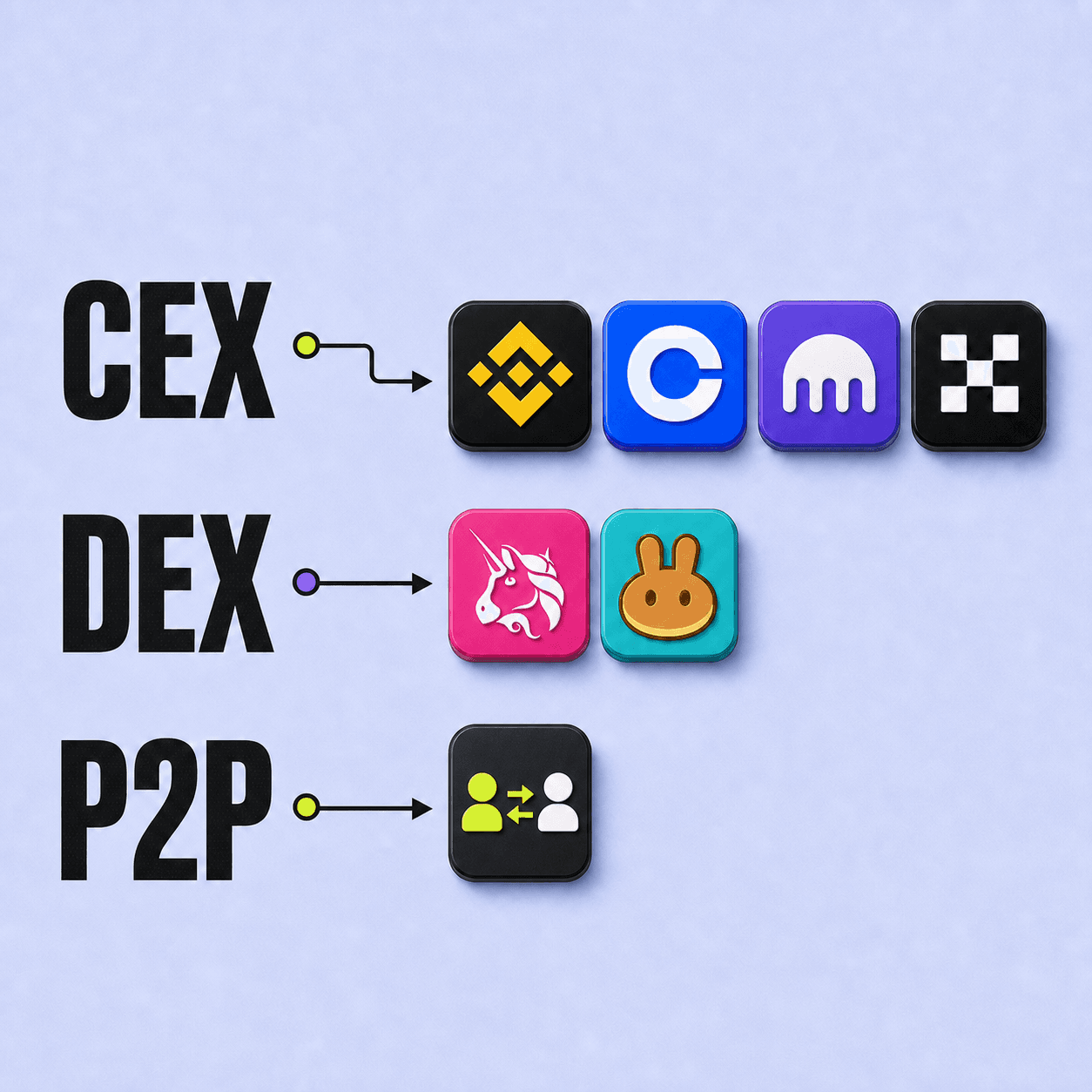
A centralized exchange, a DEX, a P2P marketplace, and an instant swap service can all convert one asset into another, but they solve different problems.
The right format depends on what you need: buying crypto with fiat, placing limit orders, swapping directly from a wallet, settling a local payment, or converting crypto without keeping a trading balance. Compare custody, supported networks, total cost, and recovery options before choosing.
Quick comparison
| Format | Best for | Who controls the funds | What to check |
|---|---|---|---|
| CEX | Fiat purchases, order books, and frequent trading | The exchange controls the private keys until withdrawal | KYC and regional access, trading and withdrawal fees, supported networks |
| DEX | Wallet-to-wallet swaps on one network and access to DeFi tokens | You control the wallet; a smart contract executes the swap | Token contract, network fee, minimum output, price impact |
| DEX aggregator | Comparing or splitting routes across on-chain liquidity | You control the wallet; smart contracts execute the selected route | Net output after gas, approvals, and route complexity |
| P2P marketplace | Buying or selling with local payment methods | The seller's crypto may be locked in platform escrow during the trade | Counterparty history, payment rules, and dispute process |
| Local or OTC desk | Cash settlement, local service, or negotiated large trades | Depends on the operator and settlement method | Legal identity, quote or spread, proof of payment, and personal safety |
| Instant swap service | Simple crypto-to-crypto conversion without a trading balance | The provider handles the deposit while routing the swap, then sends the payout | Fixed or floating quote, both networks, address or memo, and support process |
1. Centralized exchanges: CEX
A centralized exchange (CEX) runs user accounts and internal balances. You deposit fiat or crypto, trade through an order book or a simple buy-and-sell interface, and withdraw to your own wallet when finished.
The exchange holds the private keys for assets kept in its hosted wallets. Coinbase describes this custody model directly in its explanation of how hosted digital assets are held.
A CEX is usually the practical choice when you need:
- bank-card or bank-transfer access to crypto;
- limit orders, charts, or repeated trading;
- deep liquidity in major trading pairs;
- an account history and a formal support process.
Before depositing, check whether the platform serves your country, which identity checks apply, and whether it supports the exact withdrawal network you need. Trading fees are only part of the cost: withdrawal fees, conversion spreads, and temporary withdrawal holds can matter more.
2. Decentralized exchanges: DEX and AMM
A decentralized exchange (DEX) connects to a wallet that you control. You approve the token and sign the swap; a smart contract executes it on-chain. There is no exchange account holding a reusable balance.
Many DEXs use an automated market maker (AMM). Instead of matching an order with another trader, the swap uses a liquidity pool. Uniswap uses this model, and its documentation explains how pool-based swaps and output protections work.
Check these details before signing:
- the network and the token's contract address;
- the amount you will receive, not only the displayed rate;
- price impact and the allowed slippage;
- the network's native token needed for gas;
- token approvals and the smart contracts involved.
A DEX transaction normally cannot be reversed by customer support. A familiar ticker is not enough to identify a token, and a wallet on the wrong network may show a valid-looking but unusable asset.
3. DEX aggregators
A DEX aggregator searches several on-chain liquidity sources for a route. It may split one swap across multiple pools when that improves execution. 1inch is one example; its routing explanation shows why an aggregator can return a different route from a single DEX.
The quoted rate is not automatically the best final result. Compare the net output after gas, review every approval, and check which protocols the route uses. A more complex route can save on price impact but cost more to execute.
4. P2P marketplaces
A P2P marketplace connects a buyer and a seller who settle through a bank transfer, payment app, or another agreed method. The platform may lock the seller's crypto in escrow until payment is confirmed. This is different from saying that every P2P trade is decentralized or private: the marketplace may still require an account and KYC.
Use the platform's order page and chat, follow its payment rules, and release crypto only after the money is visible in the actual bank or payment account. A screenshot, email, or SMS is not proof of settlement. Binance P2P is one such marketplace, and its safety article covers common escrow and payment checks.
Review the counterparty's completed orders, cancellation rate, limits, and stated payment terms before opening a trade. If there is a dispute, keep the conversation and evidence inside the platform.
5. Local exchangers and OTC desks
A local exchange office or OTC desk can arrange cash settlement, a local bank payment, or a negotiated large trade. The service may be a registered company with an office and documented terms, or only an informal contact found in a messenger. Those are not equivalent risk levels.
Verify the operator's legal name, address, quote, spread, limits, and settlement procedure. For cash trades, use a controlled location and obtain a receipt. An informal contact usually provides no escrow, account recovery, or independent dispute process.
6. Instant swap services
An instant swap service converts crypto without asking you to maintain an exchange balance. You choose the assets and networks, provide the destination address, receive a quote, send a deposit, and wait for the payout.
This does not mean the service never handles the funds. The provider receives the deposit while it finds and executes a route, then sends the converted asset to your wallet.
Quotes can be fixed for a stated period or floating with the market. Changelly describes both models in its instant exchange FAQ. Before sending, confirm:
- whether the quote is fixed or floating and when it expires;
- the final amount after service and network costs;
- the deposit and payout networks;
- minimum and maximum amounts;
- the exact deposit amount and destination address;
- any memo or destination tag;
- the refund and support process if the route fails.
Where LightSwap fits
LightSwap is an instant crypto-to-crypto swap interface. It does not require a persistent trading balance or a mandatory account, and the standard flow starts with No KYC. A route may still require review depending on the provider, asset, or compliance conditions; the article about no-account swaps and review checks explains that distinction.
Before a deposit, the interface shows the selected assets, both networks, destination address, and quote. The provider handles the deposit during the route and sends the payout to the wallet you entered. For a concrete example, follow the BTC-to-USDT swap walkthrough.
Choose by task
- Buy with fiat or place limit orders: use a regulated CEX available in your region.
- Swap tokens on one network from your own wallet: use a reputable DEX and verify the token contract.
- Compare on-chain liquidity: use a DEX aggregator and compare net output after gas.
- Trade through a local payment method: use a P2P marketplace with escrow and an established dispute process.
- Settle cash or negotiate a large order: use a verifiable local or OTC operator.
- Convert crypto without keeping an exchange balance: use an instant swap service and verify both networks before sending.
Whichever format you choose, confirm who controls the funds during the transaction, the exact network on both sides, the full cost, and what recovery path exists if something goes wrong.
Related articles
Ready to make a swap?
Choose the pair, check the route, and continue from your wallet when you are ready.
Try itChoose assets
You send
$649.73
You receive
Rate: -
Estimated time: 1 minutes